What History Tells Us About the Rise of Fiorello La Guardia
Zohran Mamdani’s favorite mayor was nobody’s idea of a shoo-in—until he became inevitable.
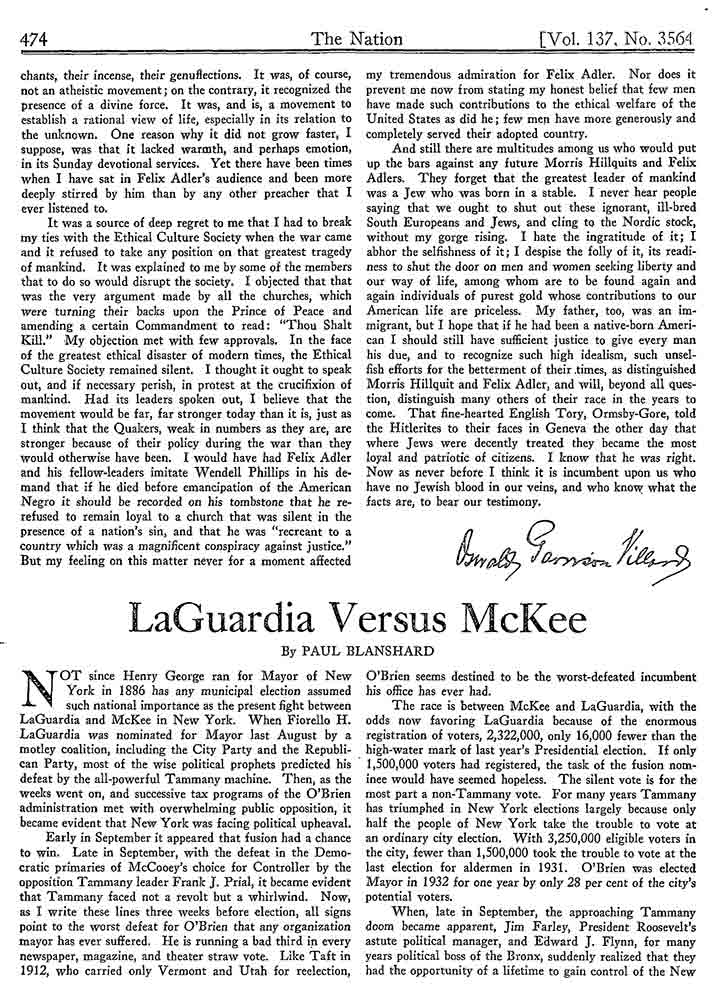
When Fiorello La Guardia was first nominated for mayor, “most of the wise political prophets predicted his defeat by the all-powerful Tammany machine,” the lawyer, humanist, and longtime Nation correspondent Paul Blanshard wrote in these pages in October 1933. But as the election approached, “it became evident that New York was facing political upheaval.”
The first sign came in the primaries, which warned of “not a revolt but a whirlwind.” Weeks later, that Depression-era whirlwind would send La Guardia to Gracie Mansion—just as a different kind of upheaval may do the same for Zohran Mamdani this fall.
Then as now, The Nation was excited about the insurgent candidate, while fully aware of the obstacles he faced: There was “still great prejudice in New York against Italian leadership,” Blanshard warned while noting that newspaper baron William Randolph Hearst regularly attacked La Guardia as “the little red flower of communism.” And if elected? Blanshard cautioned that La Guardia would have to find a way to unify “the many diverse elements that are now working for his success,” Blanshard warned—not least those “Socialists” likely to look askance at any compromises that La Guardia might have to make with the city’s powerful business elite.
Blanshard thought both sides had it wrong. “What is more important than any associations of LaGuardia’s,” he wrote, “is the forthright manner in which he has spoken in this campaign…. [I]t seems to be as certain as anything can be in politics that if he is sent to the City Hall he will exercise the vast powers of the Mayor of New York with economic insight and political independence.”
Blanshard admitted that there were limits to what La Guardia might be able to achieve. A “social revolution” would not be forthcoming: “Within the framework of our State and federal governments what could a good Mayor accomplish? He could not, even if he were a Socialist…go very far in the direction of public ownership without running afoul of the State constitution and the conservative legislature at Albany. New York does not have the power to build its own houses, operate its own buses, or own its own banks; and none of these powers can be obtained without the consent of Albany.”
Even so, La Guardia’s election would advance political and economic democracy. “From the long-range point of view,” Blanshard concluded, La Guardia’s election could not only foster “new faith in the capacity of a city to use democracy intelligently,” but even turn it into “a gigantic laboratory for civic reconstruction…. [H]is elevation to New York’s City Hall might mean a genuine new deal for a long-suffering metropolis.”
It’s a prediction that would prove astonishingly prescient. Working closely with President Franklin Roosevelt, La Guardia helped usher in an era of expansive public works and political reform that fundamentally reshaped New York. (Blanshard himself would go on to head the city’s Department of Investigations and Accounts under La Guardia, a position he used to help root out corruption.)
Of course, unlike La Guardia, a Mayor Mamdani would find no ally in the White House, at least not anytime soon. But that hasn’t dulled his appreciation for the Little Flower. When asked to name the best mayor of New York, he chose La Guardia.
Support independent journalism that does not fall in line
Even before February 28, the reasons for Donald Trump’s imploding approval rating were abundantly clear: untrammeled corruption and personal enrichment to the tune of billions of dollars during an affordability crisis, a foreign policy guided only by his own derelict sense of morality, and the deployment of a murderous campaign of occupation, detention, and deportation on American streets.
Now an undeclared, unauthorized, unpopular, and unconstitutional war of aggression against Iran has spread like wildfire through the region and into Europe. A new “forever war”—with an ever-increasing likelihood of American troops on the ground—may very well be upon us.
As we’ve seen over and over, this administration uses lies, misdirection, and attempts to flood the zone to justify its abuses of power at home and abroad. Just as Trump, Marco Rubio, and Pete Hegseth offer erratic and contradictory rationales for the attacks on Iran, the administration is also spreading the lie that the upcoming midterm elections are under threat from noncitizens on voter rolls. When these lies go unchecked, they become the basis for further authoritarian encroachment and war.
In these dark times, independent journalism is uniquely able to uncover the falsehoods that threaten our republic—and civilians around the world—and shine a bright light on the truth.
The Nation’s experienced team of writers, editors, and fact-checkers understands the scale of what we’re up against and the urgency with which we have to act. That’s why we’re publishing critical reporting and analysis of the war on Iran, ICE violence at home, new forms of voter suppression emerging in the courts, and much more.
But this journalism is possible only with your support.
This March, The Nation needs to raise $50,000 to ensure that we have the resources for reporting and analysis that sets the record straight and empowers people of conscience to organize. Will you donate today?